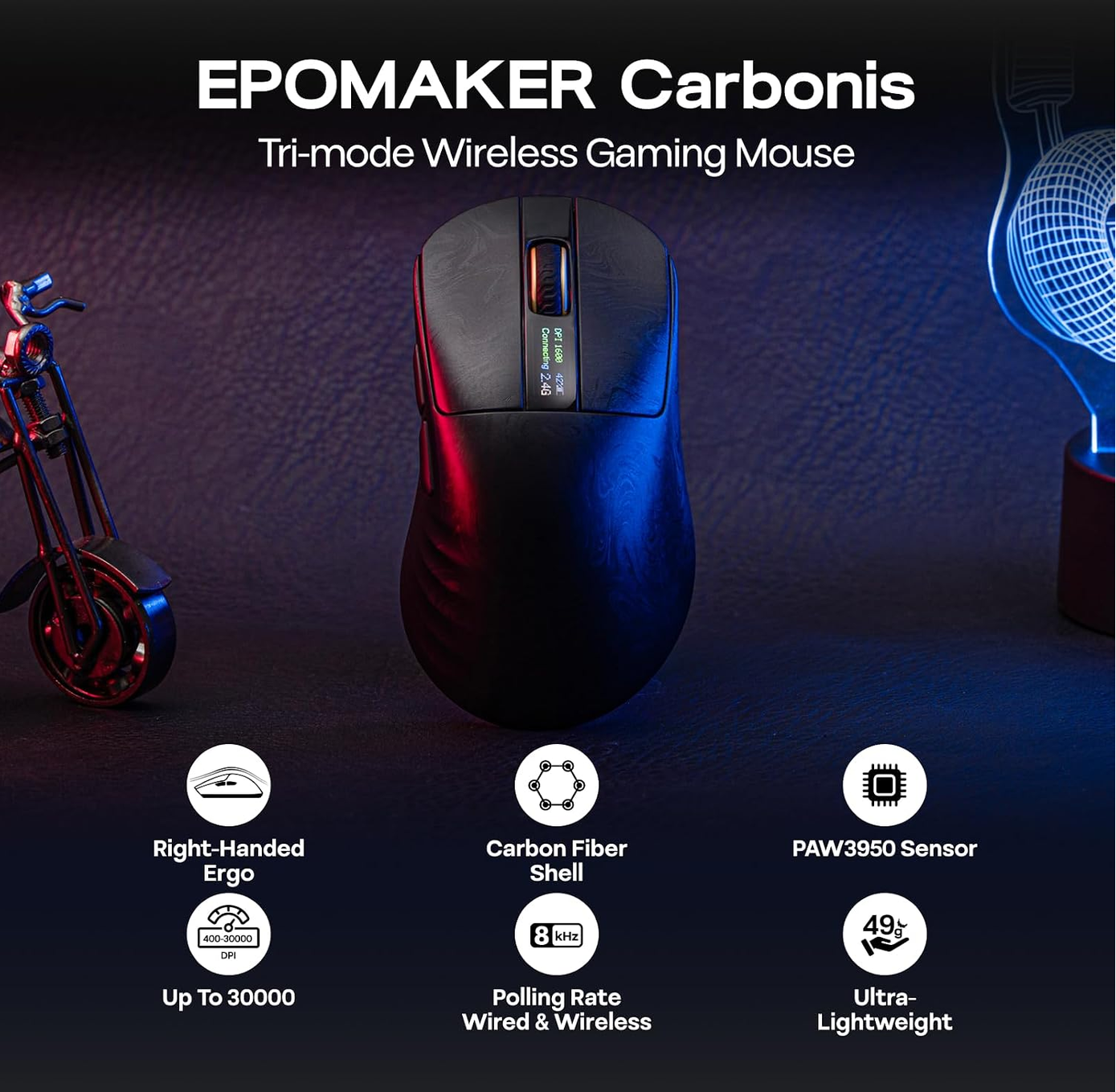
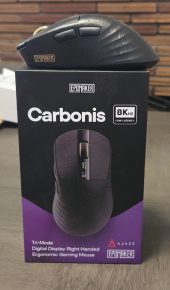
The Epomaker Carbonis is a right-handed wireless gaming mouse that stands out for its carbon-fiber composite shell, flagship-level performance hardware, and a small onboard LCD. Priced around $86, it targets competitive and enthusiast gamers who want extreme lightness without a honeycomb shell, plus a few unique conveniences.
Design and Build
At roughly 50 g, the Carbonis is impressively light for a solid (non-honeycomb) mouse. The carbon-fiber composite shell keeps it rigid with no flex, while a laser-matte finish and subtle carbon patterning give it a premium, distinctive look. Available in black forged-carbon and purple/black gradient variants, it looks more refined than typical plastic gaming mice.
The shape is an ergonomic right-handed design sized for medium-to-large hands (dimensions ≈ 123 × 66 × 43 mm). The palm contour is generally comfortable during longer sessions, with good side contours near the two side buttons. Main buttons use a PC + carbon-fiber construction with Raesha optical switches for a crisp, consistent feel; the side buttons are standard ABS. The scroll wheel is solid and well-textured.
Performance and Specs
The heart of the Carbonis is the PixArt PAW3950 sensor (up to 30,000 DPI, 750 IPS, 50G acceleration) paired with a Nordic MCU. It supports native 8000 Hz polling on both wired and 2.4 GHz wireless (default 1000 Hz), with advertised latencies of ~0.3 ms wired and ~0.375 ms wireless. Bluetooth is limited to 125 Hz.
In practice, tracking is smooth and precise across cloth and other surfaces. The high polling rate and sensor combination deliver competitive responsiveness for FPS and other fast-paced games. DPI stages are 400 / 800 / 1600 / 3200 / 6400 / 30,000, adjustable on the mouse or via software. Most users will stay well below the maximum, but the headroom is there.
Standout Features
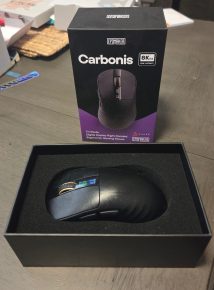
The small glass LCD (≈ 21.7 × 8.5 mm) sits near the scroll wheel and shows real-time DPI, battery percentage, connection mode, and polling rate. It automatically blanks during movement to save power and lights up after a few seconds of idle. This is genuinely useful for quick checks without opening software, and you can cycle polling rates or DPI stages using button combinations on the mouse itself.
Configuration is handled through a browser-based web driver (Chrome/Edge recommended)—no desktop install required. It covers button remapping, macros, LOD (lift-off distance), motion sync, sleep settings, and more, with onboard memory for profiles. Tri-mode connectivity (2.4 GHz dongle, Bluetooth 5.0, and USB-C wired) adds flexibility for PC, laptop, tablet, or phone use.
Battery Life and Everyday Use
The 300 mAh battery is the main compromise for the low weight. Typical mixed use at 1000 Hz lands around 30–40 hours for many users; higher polling rates (especially 8000 Hz) drop this significantly (often into the 15–20 hour range or less depending on screen use). Fast charging (under an hour to full) helps mitigate this—you can top it up quickly or play wired while charging. The screen’s power-saving behavior is smart but can make low-battery warnings easy to miss mid-session.
The included 2.4 GHz dongle is functional but not the smallest or flattest; Bluetooth works fine for productivity or multi-device use. Spare feet are included, and overall build quality earns consistent praise for feeling durable despite the featherweight design.
Pros and Cons
Pros
- Exceptionally light (~50 g) yet rigid carbon-fiber composite shell
- Flagship PAW3950 sensor + native 8K polling
- Useful onboard LCD for status at a glance
- Comfortable ergo shape for medium-large right hands
- Tri-mode connectivity and web-based (no-install) software
- Fast charging and solid optical main switches
- Distinctive, premium look
Cons
- Modest battery life, especially at high polling rates
- Right-handed only
- Screen blanks during use (can hide low-battery alerts)
- Software best with Chrome/Edge
- Price is competitive but not bargain-bin for the category
Verdict
The Epomaker Carbonis is a strong performer that successfully combines ultralight construction, high-end sensor performance, and a practical (if slightly gimmicky) LCD in a solid shell. It is best suited to right-handed gamers with medium-to-large hands who prioritize low weight, precision, and convenience over maximum battery endurance. At $86 it competes well against other premium lightweight options, particularly if the carbon-fiber aesthetic and on-mouse display appeal to you.
Highly recommended for its intended audience, with the battery life as the primary caveat.